
Cultivating Mental Elegance
Raising your EQ & Social Intelligence, Learning How To Read People, Reading The Room
COMPLEMENTARITY AS THE CENTER
Again, I’d like to start this section by emphasizing the philosophy of Complementarity. You need to understand what kind of a partner your man wants in you if you both weren’t clear enough on that in the beginning. Exceptional Men have different philosophies when it comes to choosing a partner. Some want just a beautiful woman, with a lot of feminine & sensual energy. That’s very hackable - you must focus on the exterior, and spiritual part of your being. And it’s very hackable at any point of your life - you just need the right tools, a good mentor, & the right target haha!
However, some want an Ally, a woman that will show him a different perspective. A woman that he’ll be able to turn to on a business meeting - and he’d be able to use her intuition and ask for advice, that feminine intuition, another, broader perspective.
Men are cold & logical. We, women, are empathetic, we have a fluid & flowy nature that allows us to adapt and conform to different social situations. Nature made us like that to be able to save ourselves for bearing children in safety. That’s our evolution. And because of that - we are more susceptible to sense slightest changes in human behavior, slightest misalignments, in case the person in front of us is secretly dangerous.
A philosophy of Complementarity is an ultimate win. The strengths of one compensate for the weaknesses of the other. And, as women, our primal Superpower is our predisposition to have higher EQ & read people better aka Social Intelligence.
Mental Elegance is a skill that you can possess by:
exposing yourself more to the world, getting out there, making a lot of mistakes, & learning from it if you are courageous enough to do so;
finding a mentor that has a high EQ level, has seen it all, & can share his or her experience with you. Your only concern would be to understand whether he or she were in the rooms where you would want to be;
reading thoughts of Great people, studying different philosophies & religions, exposing yourself to different life views;
not being afraid to objectively look at the philosophies of life different to yours (no emotions attached - as if you are a mineralogist and you just found a new stone);

See People As They Are:
Social Intelligence
Often the greatest obstacle to our pursuit of mastery comes from the emotional drain we experience in dealing with the resistance an manipulations of the people around us.
If we are not careful, our minds become absorbed in endless political intrigues and battles.
The principal problem we face in social arena is our naive tendency to project onto people our emotional needs and desires of the moment.
We misread their intentions and react in ways that cause confusion or conflict.
Social intelligence is the ability to see people in the most realistic light possible.
By moving past our usual self-absorption, we can learn to focus deeply on others, reading their behavior in the moment, seeing what motivates them, and discerning any possible manipulative tendencies. Navigating smoothly the social environment, we have more time and energy to focus on learning and acquiring skills.
Success attained without this intelligence is not true mastery, and will not last.

You must allow everyone the right to exist in accordance with the character he has, whatever it turns out to be: and all you should strive to do is to make use of this character in such a way as its kind of nature permits, rather than to hope for any alteration in it, or to condemn it offhand for what it is. This is the true sense of the maxim — Live and let live…. To become indignant at [people’s] conduct is as foolish as to be angry with a stone because it rolls into your path. And with many people the wisest thing you can do, is to resolve to make use of those whom you cannot alter.
— Arthur Shopenhauer
KEYS TO SOCIAL INTELLIGENCE
Notes on the quote above: that idea mirrors the gist of Stoicism quite a lot - don’t get emotional about things you cannot really control (people).
Note 2: A lot of our studying here is based on the works & researches of many different psychologists, sociologists, businessmen, Leyla’s perspectives on the world, anthropologists & scientists, grasping different religions & philosophies. If you are interested in the list of Literature that was used - have a talk with Leyla, or her team.
You cannot let your childish elusions about people distort your view of them. A lot of us carry our childhood perspective on the world into the Adulthood. Some maintain it their whole life without understanding why they cannot succeed in life. And people who retain to their childish attitudes will rarely be able to hold on to the success they may achieve through their talent.
Social Intelligence is nothing more than the process of discarding the naivety and approaching something more realistic. It involves focusing our attention outward instead of inward, honing on observational and empathetic skills we naturally possess.
It means moving past our tendency to idealize and demonize people, and seeing and accepting them as they are. It is a way of thinking that must be cultivated as early as possible.
Let’s look at how Robert Green structures the understanding of achieving mastery in life.
Naïve Perspective
Apprenticeship Phase
Creative-Active Phase
Mastery
Components of Social Intelligence
1) Specific Knowledge of Human Nature:
the ability to read people;
to get a feel for how they see the world;
to understand their individuality;
2) General Knowledge of Human Nature:
accumulating an understanding of the overall patterns of human behavior that transcend us as individuals;
including some of the darker qualities we often disregard;

Naïve Perspective
The Naïve Perspective makes us feel sensitive and vulnerable. Looking inward as to how the words and actions of others implicate us in some way, we continually misread their intentions. We project our own feelings onto them. We have no real sense of what they are thinking or what motivates them. With colleagues in the work environment, we fail to see the source of their envy or the reason for their manipulations; our attempts at influencing them are based on the assumptions that they want the same things as ourselves. With mentors and bosses, we project onto them our childhood fantasies, becoming unnecessarily adoring or fearful of authority figures and creating stormy and brittle relationships in the process. We think we understand people, but we are viewing them through a distorted lens. In this state, all of our empathic powers are rendered useless.
EXAMPLE:
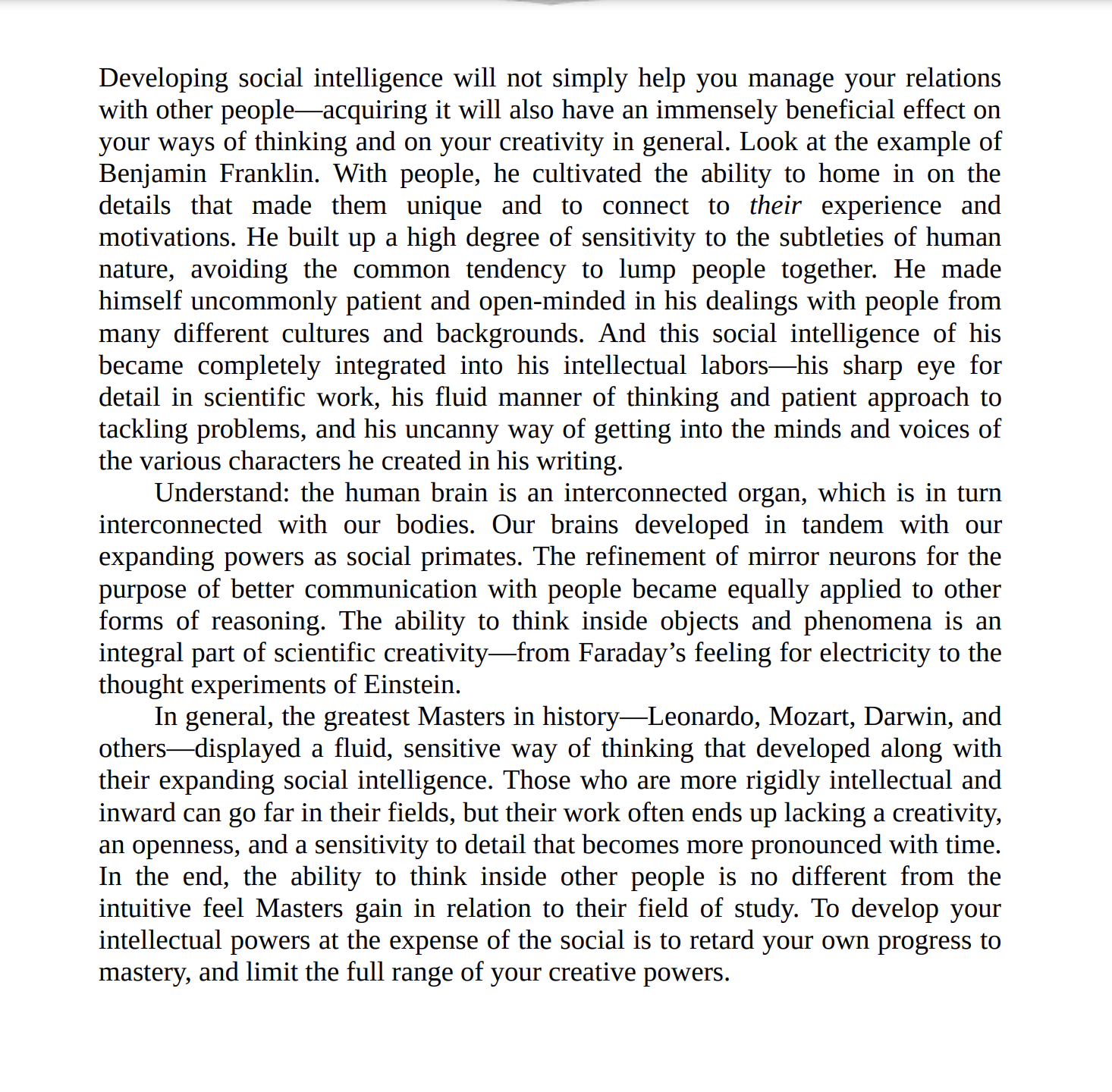
Benjamin Franklin, the icon of social intelligence and the clearest example of the role it plays in mastery. As the second youngest of a large extended family, he learned to get his way through charm. As he got older he came to believe, as many young people do, that getting along with others is a function of behaving charmingly and winning them over with a friendly manner. But as he engaged with the real world, he began to see his charm as the actual source of his problem. Being charming was a strategy he had developed out of childish need; it was a reflection of his narcissism, of the love he had of his own words and wit. It had no relation to other people and their needs. It did not prevent them from exploiting or attacking him.
To be truly charming and socially effective you have to understand people, and to understand them you have to get outside yourself and immerse your mind in their world.
Only when he realized how deeply naïve he had been could he take the necessary steps to move past this naïveté. His focus on gaining social intelligence was the turning point of his career — it transformed him into the preeminent observer of human nature, a man with a magical ability to see into people. It also made him the perfect social companion — men and women everywhere fell under his spell because of his ability to attune himself to their energies. With tranquil and productive social relations, he could focus more of his time and attention to writing, to questions of science, to his endless inventions — to mastery.
It might be deduced from Benjamin Franklin’s story that social intelligence requires:
a detached, emotionless approach to people, making life rather dull in the process, but this is hardly the case.
Franklin himself was by nature a very emotional man. He did not repress this nature, but rather turned his emotions in the opposite direction. Instead of obsessing over himself and what other people were not giving him, he thought deeply of how they were experiencing the world, what they were feeling and missing. Emotions seen inside other people create empathy and bring a deep understanding of what makes them tick. For Franklin, this outward focus gave him a pleasant feeling of lightness and ease; his life was hardly dull, but simply free of unnecessary battles.
Understand: you will continue to have problems in attaining social intelligence until you come to the realization that your view of people is dominated by the Naïve Perspective.
Following Franklin’s example, you can reach this awareness by reviewing your past, paying particular attention to any battles, mistakes, tensions, or disappointments on the social front. If you look at these events through the lens of the Naïve Perspective, you will focus only on what other people have done to you — the mistreatments you endured from them, the slights or injuries you felt. Instead, you must turn this around and begin with yourself — how you saw in others qualities they did not possess, or how you ignored signs of a dark side to their nature. In doing this, you will be able to clearly see the discrepancy between your illusions about who they are and the reality, and the role you played in creating this discrepancy. If you look closely enough, you can often perceive in your relationships with bosses or superiors reenactments of the childhood family dynamic — the idealizing or demonizing that has become habitual.
By making yourself aware of the distorting process of the Naïve Perspective, you will naturally grow less comfortable with it. You will realize that you are operating in the dark, blind to people’s motivations and intentions, vulnerable to the same mistakes and patterns that occurred in the past. You will feel your lack of real connection to other people. The desire will naturally arise from within to change this dynamic—to start looking outward instead of focusing only on your own feelings, to observe before you react.
REMEDY:
This new clarity about your perspective should be accompanied by an adjustment of your attitude. You must avoid the temptation to become cynical in your approach as an overreaction to your prior naïveté. The most effective attitude to adopt is one of SUPREME ACCEPTANCE. The world is full of people with different characters and temperaments. We all have a dark side, a tendency to manipulate, and aggressive desires. The most dangerous types are those who repress their desires or deny the existence of them, often acting them out in the most underhanded ways. Some people have dark qualities that are especially pronounced. You cannot change such people at their core, but must merely avoid becoming their victim. You are an observer of the human comedy, and by being as tolerant as possible, you gain a much greater ability to understand people and to influence their behavior when necessary.
With this new awareness and attitude in place, you can begin to advance in your apprenticeship in social intelligence.
In simple words: after adapting a mindset of Supreme Acceptance, only after that, after escaping the Naive Perspective - you can truly start learning the art, the science of Social Intelligence.

Specific Knowledge - How To Read People
Most of us have had the sensation at some point in our lives of experiencing an uncanny connection with another person. In such moments we have an understanding that is hard to put into words; we even feel that we can anticipate the thoughts of the other person. Such communication generally occurs with close friends and partners, people whom we trust and feel attuned to on many levels. Because we trust them, we open up to their influence and vice versa. In our normal state we are often nervous, defensive, and self-absorbed, and our minds are turned inward. But in these moments of connection, the internal monologue is shut off, and we pick up more cues and signals from the other person than usual.
What this means is that when we are…
not inward-directed,
but attending more deeply to another person,
-> we gain access to forms of communication that are largely NONVERBAL in nature, and quite effective in their own way.
We can imagine that our primitive ancestors, needing to cooperate on a high level yet not experiencing the kind of interior monologue that comes with words, possessed an incredibly powerful sensitivity to the moods and feelings of others within the group, bordering on telepathy. This would be similar to what other social animals possess, but in this case this sensitivity would have been heightened by our ancestor’s ability to place themselves in the minds of others.
The intense nonverbal connection we experience with those we are close to is clearly not appropriate in a work environment, but to the degree we open ourselves up and direct our attention outward to other people, we can access a part of the sensitivity that our ancestors had, and become much more effective at reading people.
Specific Knowledge—Reading People
To begin this process, you need to train yourself to pay less attention to the words that people say and greater attention to their tone of voice, the look in their eye, their body language—all signals that might reveal a nervousness or excitement that is not expressed verbally. If you can get people to become emotional, they will reveal a lot more. Cutting off your interior monologue and paying deep attention, you will pick up cues from them that will register with you as feelings or sensations. Trust these sensations—they are telling you something that you will often tend to ignore because it is not easy to verbalize. Later you can try to find a pattern to these signals and attempt to analyze what they mean.
On this nonverbal level, it is interesting to observe how people behave around those in positions of power and authority. They will tend to reveal an anxiety, a resentment, or a sycophantic falseness that betrays something essential about their psychological makeup, something that goes back to their childhoods and that can be read in their body language.
When you drop your defense mechanisms and pay deep attention to others, you will need to lower your guard and open yourself up to their influence as well. But as long as your emotions and empathy are directed outward, you will be able to detach yourself when necessary and analyze what you have gleaned. Resist the temptation to interpret what they say or do as somehow implicitly involving you—this will cause you to turn your thoughts inward and close off the immediacy of the connection.
TAKE IN EVERY WORD FROM NOW ON.
Exercise
After you have known people for a while, try to imagine that you are experiencing the world from their point of view, placing yourself in their circumstances and feeling what they feel.
Look for any common emotional experiences — a trauma or difficulty you’ve had, for instance, that resembles in some way what they are going through. Reliving a part of that emotion can help you begin the identifying process. The goal is not to literally inhabit their mind, which is impossible, but to practice your empathic powers and gain a more realistic appraisal [expertise] of their worldview. Being able to place yourself to any degree in the mind-set of others is a brilliant means of loosening up your own thought process, which will tend to get locked into certain ways of seeing things. Your ability to empathize with others is related to the creative process of feeling your way into the subject you are studying.
This intuitive form of reading people becomes more effective and accurate the more you use it, but it is best to combine it with other, more conscious forms of observation.
For instance, you should take particular note of people’s actions and decisions.
Your goal is to figure out the hidden motives behind them, which will often revolve around POWER.
People will say all kinds of things about their motives and intentions; they are used to dressing things up with words. Their actions, however, say much more about their character, about what is going on underneath the surface. If they present a harmless front but have acted aggressively on several occasions, give the knowledge of that aggression much greater weight than the surface they present. In a similar vein, you should take special note of how people respond to stressful situations — often the mask they wear in public falls off in the heat of the moment.
{That’s why when people are in a ‘heated’ mode - I just let them be who they are. The faster they show it - the better.}
Life Example 1.
I was in a taxi with my male colleague, a successful entrepreneur from UK. We just got to know each other a couple days ago, and decided to have a dinner together (not a date, business connection). At a certain point while talking in a taxi - he started looking at me very intently. Like a wolf. Pinning me with his eyes.
Me, being my raw & simple self, I immediately (non-verbally, intentionally) showed him that I am uncomfortable by:
looking away constantly & breaking the eye contact (usually, I am very comfortable with maintaining the eye contact with all people, I don’t care about their status or how much money they make);
I made my breath a bit faster & ripped;
I made my eyebrows go a little bit up;
I made my speech ripped, started stuttering & forgetting the words I wanted to say, prolonging the ends of the sentence, adding ‘uhm’ almost after every word as the speech became less flowy;
the tone became base-less (lack of breath), it was harder to maintain my alto, so it turned close to soprano;
I INTENTIONALLY LET HIM KNOW HOW I WAS RESPONDING TO A STRESSFUL SITUATION {go back up again to the theory} by showing that I am uncomfortable, and that I basically turn into a rabbit.
A true gentleman would pick the cues up, and adjust his behavior. And I knew that. And a man who is NOT a gentleman - would continue this despite all of my cues. I don’t hang around with the latter, they allow themselves too much, act disrespectful, and finally - they hurt you. As Britains would say - cunts.
At a certain point, my playful self and my emotionally & socially intelligent self got so curios that I couldn’t hold it anymore. I stopped talking. Smiled. Got my cute eyes up, tilted my head to the side in a childish manner to let his guard off, and asked with a curiosity of a child - “Why are you looking at me like that?”.
He immediately stopped looking at me with his wolf eyes, smiled - even smirked - and said: “I made you uncomfortable hm?” I said, still smiling: “Yes. Why the unbreakable eye contact? I even started stuttering & forgetting my words haha!”. We both knew we were hyper detail-oriented and could read through people at a good level. Till that point - he was nothing but a Gentleman with a capital G. So this exact behavior was new to me, and I couldn’t understand the underlying reason for it.
He replied: “I was testing how you handle stress, how resistant you are to a stressful situation”. At first, I honestly couldn’t believe what I heard, so I laughed at how inappropriate yet honest he was! And then I said:
— Oh, I am terrible at handling those haha!
— Yes, you have like no stress resistance haha! Immediately started stuttering, and looking away.
He was talking only about stress resistance, but he never mentioned the real reason why he did that. Which was deadly smart of him. Unless he could read me even deeper, and understood that I was playing a sheep? Playing a sheep is one of the strongest strategies too - others underestimate you while you are busy executing the actual mission / task - whatever it is. I honestly think he’d suspected that I could be one of those smart ones who played a sheep.
But truly - I was actually uncomfortable haha. I noticed in myself - that at first I WAS controlling my reaction, but my physical part took over, and I could actually feel blood boiling because of the fear: “I am still young, and I look like a bunny, and I know it”.
So, out of this situation, he got 2 things out of me:
He understood my stress resistance (can be beneficial for understanding how easy it would be to sell me for whatever venture he had in mind - business or relationships);
He saw my un-masked real self. Which is a bunny. When I am stressed, I cannot even be angry at others. I just turn simple. So he understood that I, potentially, wasn’t of any harm.
“The faster people get to show their true self in a stressful situation - the better! All of their masks fall off, and you get to know who they actually are underneath all of it”.
My next thoughts were: “Okay, this one is incredibly dangerous & deadly smart. He is picking up every cue, every detail of my behaviour and attitude. Another level of social & emotional intelligence. I must remain alert, just to not let myself into any trouble. If he is that smart - it would be a no-brainer for him to manipulate me into whatever he wants. Good that I understand it. Let’s keep going & see what I’m capable of”.
My usual strategy - no masks. LET them know you are uncomfortable non-verbally first. And if nothing changes - tell them. I know that my rawness is refreshing. I am straightforward. That’s refreshing too. I am honestly easy to read. Because I usually have nothing to hide really. I am comfortable in my own skin, with who I am, what I want, what I do & how I work. Hence - there’s nothing to target really. No underlying mysteries, no skeletons in my closet. I accept my past mistakes, and I understand that I am not my mistakes. So, socially, it’s easier for me to read people. As you remember, reading people requires pointing your attention OUTwards. And when you do that - some of your guard naturally falls off, you expose yourself. You cannot control 2 dimensions at the same time with the same intensity. No-one can. BUT when you have nothing to hide really, when you let your guard off - nothing changes. So, it’s a win-win strategy, in my opinion. A strategy of no fears, raw & simple approach.
Potential strategy - to immediately set a resting bitch face, and scream at the man, some would try to bring the man down etc etc. That’s very masculine, non-elegant, and not smart. Because you are letting them know they brought out a VERY strong emotion out of you - Anger. That’s a VERY strong emotion. And if they were able to do so - that means you show them that they are able to manipulate you & your emotions. Don’t do that. You don’t need it. Well, unless it’s a strategy, of course.
If you show them that they can bring out such a strong emotion - you give them all the tools. Now you are their puppet, and they know there’s actually something in you that you are hiding. And it irritates you. Moreover, you show that you are self-absorbed, and you cannot control your emotions. You are easy to influence. They tickle your ego just a bit - and you are already fiery. There’s a lot of inertia in you. You let your unconscious self guide you - such people are not in control of their lives. A lot of the times, if they’d let inertia in one dimension (like emotions) - they’ll allow their subconscious to lead them in another like:
they will be easily susceptible to be seduced;
drinking, smoking habits that they are not conscious of;
emotional buyers;
emotionally agreeing to business ventures (without strategically thinking through, using their cold mind & logic - those are the pillars of successful long-term business);
So - you see how just ONE reaction, ONE behavior of yours shows other Socially & Emotionally Intelligent people your WHOLE BEING, and what your are predisposed to?
I want you to take your emotions & reactions under control. Become aware of the subconscious by putting light in there, learning about it.
You choose what you show.
Specific Knowledge -
Reading People
Establishing Obsession With Details
In general, you are reading and decoding every possible sign — including:
the clothes they wear
the organized or disorganized nature of their workspace.
The choice of mate or partner can be quite eloquent too, particularly if it seems slightly inconsistent with the character they try to project.
In this choice they can reveal unmet needs from childhood, a desire for power and control, a low self-image, and other qualities they normally seek to disguise.
What might seem like small issues —
chronically being late,
insufficient attention to detail,
not returning any favors on your part,
— are signs of something deeper about their character.
These are patterns you must pay attention to. Nothing is too small to notice.
You must avoid the common mistake of making judgments based on your initial impressions of people. Such impressions can sometimes tell you something, but more often they are misleading. There are several reasons for this. In your initial encounter you tend to be nervous, less open, and more inward. You are not really paying attention. Furthermore, people have trained themselves to appear a certain way; they have a persona they use in public that acts like a second skin to protect them. Unless you are incredibly perceptive, you will tend to mistake the mask for the reality. For instance, the man you judged to be so powerful and assertive may be merely masking his fears and may have far less power than you first imagined.
Often it is the quiet ones, those who give out less at first glance, who hide greater depths, and who secretly wield greater power.
What you want is a picture of a person’s character over time, which will give you a far more accurate sense of their true character than any first impression could. So restrain yourself from the natural tendency to judge right away, and let the passing months reveal more and more about who people are, as you get better at reading them. In the end, your goal is to identify and pierce through to what makes people unique, to understand the character and values that lie at their cores.
The more you can fathom about people’s pasts and their way of thinking about things, the more deeply you can enter into their spirit.
In this way you will be able to understand their motivations, foresee their actions, and recognize how best to win them to your side. You will no longer be operating in the dark.
You will encounter thousands of various individuals in your life, and the ability to see them as they are will prove invaluable.
Keep in mind, however, that people are in a state of continual flux. You must not let your ideas about them harden into a set impression.
You are continually observing them and bringing your readings of them up to date.
Let the passing months reveal more & more about who people are.
Summary || Reading People
Cut off Internal Monologue;Focus attention OUTwards, on other people;Extreme Obsession With Details: nothing can be left unnoticed;Training Empathy allows you to understand people better, and on a deeper level: > imagine living through their life & experiences, >> this will help to foresee their actions;Restrain the urge to judge right away;Let the passing months reveal more & more about the person;Observe, Observe, Observe

General Knowledge - The 7 Deadly Realities
Throughout recorded history we can detect patterns of human behavior that transcend culture and time, indicating certain universal features that belong to us as a species. Some of these traits are quite positive — for instance, our ability to cooperate with one another in a group — while some of them are negative and can prove destructive. Most of us have these negative qualities —
Envy
Conformism
Rigidity
Self-obsessiveness
Laziness
Flightiness
Passive Aggression
— in relatively mild doses. But in a group setting, there will inevitably be people who have one or more of these qualities to a high enough degree that they can become very destructive. We shall call these negative qualities the Seven Deadly Realities.

Avoid Triggering
The problem for us is that people do not like to display these traits publicly because they are seen as ugly and undesirable. They tend to disguise them from view, finally revealing their reality through some action that blindsides and harms us. In our surprise, we tend to react emotionally, increasing the damage, the effects of which we can carry with us the rest of our lives. Through study and observation, we must understand the nature of these Seven Deadly Realities so that we can detect their presence and avoid triggering them in the first place. Consider the following as essential knowledge in acquiring social intelligence.
>>> After looking into 7 Deadly Realities, Learn How To Get Rid of them yourself

Envy [1/2]
It is our nature to constantly compare ourselves to others—in terms of money, looks, coolness, intelligence, popularity, or any number of categories. If we are upset that someone we know is more successful than we are, we will naturally experience some envy, but often we will find a way to minimize it because it is an unpleasant emotion. We tell ourselves that the success of another person is a matter of luck or came through their connections, or that it won’t last. But for some people it goes much deeper than this, usually because of the level of their insecurities. Seething [boiling] with envy, the only way to discharge it is to find a way to obstruct or sabotage the person who elicited the emotion. If they take such action they will never say it is because of envy, but will find some other, more socially acceptable excuse. They often won’t even admit their envy to themselves. This makes it a quality very hard to recognize in people. There are, however, a few indications you can look for.
People who praise you too much or who become overly friendly in the first stages of knowing you are often envious and are getting closer in order to hurt you. You should be wary of such behavior.
Also, if you detect unusual levels of insecurity in a person, he or she will certainly be more prone to envy.
Envy [2/2]
In general, however, envy is very difficult to discern, and the most prudent course of action is to make sure your own behavior does not inadvertently trigger it.
If you have a gift for a certain skill, you should make a point of occasionally displaying some weakness in another area, avoiding the great danger of appearing too perfect, too talented.
If you are dealing with insecure types, you can display great interest in their work and even turn to them for advice. You must be careful not to boast of any success, and if necessary, to ascribe it to just good luck on your part. It is always wise to occasionally reveal your own insecurities, which will humanize you in other people’s eyes. Selfdeprecating humor will work wonders as well. You must be particularly careful to never make people feel stupid in your presence.
Intelligence is the most sensitive trigger point for envy. In general, it is by standing out too much that you will spark this ugly emotion, and so it is best to maintain a nonthreatening exterior and to blend in well with the group, at least until you are so successful it no longer matters.

Conformism
When people form groups of any type, a kind of organizational mind-set inevitably sets in. Although members of the group might trumpet their tolerance and celebration of people’s differences, the reality is that those who are markedly different make them feel uncomfortable and insecure, calling the values of the dominant culture into question.
If you have a rebellious or naturally eccentric streak, as is often the case with those who are aiming for mastery, you must be careful in displaying your difference too overtly, particularly in the Apprenticeship Phase.
Let your work subtly demonstrate your individual spirit, but when it comes to matters of politics, morals, and values, make a show of adhering to the accepted standards of your environment.
Think of the workplace as a kind of theater in which you are always wearing a mask. (Reserve your most interesting and colorful thoughts for your friends, and for those whom you can trust outside work.) Be careful in what you say — it is not worth the bother of freely expressing your opinions. If you sin against this Deadly Reality, people will not acknowledge the cause of their disaffection, because they do not want to think of themselves as conformists. They will find some other reason to ostracize or sabotage you. Do not give them material for this kind of attack. Later, as you gain mastery, you will have ample opportunity to let your individuality shine through and to reveal your contempt for people’s correctness.

Rigidity
The world has become increasingly complex in many ways, and whenever we humans face a situation that seems complicated our response is to resort to a kind of artificial simplicity, to create habits and routines that give us a sense of control. We prefer what is familiar — ideas, faces, procedures— because they are comforting. This extends to the group at large. People follow procedures without really knowing why, simply because these procedures may have worked in the past, and they become highly defensive if their ways are brought into question.
They become hooked on a certain idea and they hold on to it, even if that idea has been proven repeatedly to be wrong.
Look at the history of science: whenever a new idea or way of looking at the world is introduced, despite all of the proofs behind it, those who are entrenched in the old ways will fight to the death to preserve them.
It is often against human nature, particularly as we get older, to consider alternative ways of thinking or doing things. People do not advertise their rigidity. You will only trip up against it if you try to introduce a new idea or procedure. Some in the group — the hyper-rigid— will become irritable, even panicky at the thought of any kind of change. If you press your case with logic and reason, you will tend to make them even more defensive and resistant. If you are an adventurous, open-minded type, your very spirit will prove disruptive and upsetting. If you are not aware of the dangers of butting up against this fear of the new, you will create all sorts of hidden enemies, who will resort to anything to conserve the old order.
It is useless to fight against people’s rigid ways, or to argue against their irrational concepts. You will only waste time and make yourself rigid in the process.
The best strategy is to simply accept rigidity in others, outwardly displaying deference to their need for order.
On your own, however, you must work to maintain your open spirit, letting go of bad habits and deliberately cultivating new ideas.

Self-Obsessiveness
The world is a harsh and competitive place, and we must look after our own interests. Even when we act for the greater good, we are often unconsciously motivated by the desire to be liked by others and to have our image enhanced in the process. There is no shame in this.
But because being self-interested does not make us feel or appear noble, many people go out of their way to disguise their self-interest. Often those who are the most self-absorbed will surround their actions with a moral or saintly aura, or will make a show of supporting all of the right causes. Confused by these appearances, when it is time to ask such people for assistance, you will often appeal to their sense of gratitude, their seemingly charitable nature, or their friendly feelings. You are then frustrated and disappointed when they politely decline to help you, or put you off long enough that you give up. Of course, they never reveal the real reason for this behavior — that there is nothing in it for themselves.
Instead of putting yourself in this position, you must understand and accept this Deadly Reality. When it is time to ask for a favor or help, you must think first of appealing to people’s self-interest in some way. (You should apply this to everyone, no matter their level of self-obsessiveness.) You must look at the world through their eyes, getting a sense of their needs. You must give them something valuable in exchange for helping you — a return favor that will save them time, a contact they need, and so on. Sometimes the chance to look good in doing you a favor or supporting a cause will suffice, but it is generally better to find something stronger than that — some concrete benefit they can foresee coming from you in the future. In general, in your interactions with people, find a way to make the conversations revolve around them and their interests, all of which will go far to winning them to your side.

Laziness
We all have the tendency to want to take the quickest, easiest path to our goals, but we generally manage to control our impatience;
we understand the superior value of getting what we want through hard work.
For some people, however, this inveterate lazy streak is far too powerful. Discouraged by the thought that it might take months or years to get somewhere, they are constantly on the lookout for shortcuts. Their laziness will assume many insidious forms. For example, if you are not careful and talk too much, they will steal your best ideas and make them their own, saving themselves all of the mental effort that went into conceiving them.
They will swoop in during the middle of your project and put their name on it, gaining partial credit for your work.
They will engage you in a “collaboration” in which you do the bulk of the hard work but they share equally in the rewards. Your best defense is your prudence.
Keep your ideas to yourself, or conceal enough of the details so that it is not possible to steal them.
If you are doing work for a superior, be prepared for them to take full credit and leave your name out (this is a part of everyone’s apprenticeship and must be accepted as such), but do not let this happen with colleagues. Secure your credit in advance as part of the terms of working together. If people want you to do work for them, then pass it off as a “collaborative” effort, always gauge whether such work will add to your skill base, and examine their past record to measure the intensity of their work ethic. In general, be wary of people who want to collaborate — they are often trying to find someone who will do the heavier lifting for them.

Flightiness
We like to make a show of how much our decisions are based on rational considerations, but the truth is that we are largely governed by our emotions, which continually color our perceptions. What this means is that the people around you, constantly under the pull of their emotions, change their ideas by the day or by the hour, depending on their mood.
You must never assume that what people say or do in a particular moment is a statement of their permanent desires.
Yesterday they were in love with your idea; today they seem lukewarm. This will confuse you and if you are not careful, you will waste valuable mental space trying to figure out their real feelings, their mood of the moment, their fleeting motivations. It is best to cultivate both distance and a degree of detachment from other people’s shifting emotions so that you are not caught up in the process. Focus on their actions, which are generally more consistent, and not on their words. Do not take so seriously people’s promises or their ardor in wanting to help you. If they come through, so much the better, but be prepared for the more frequent change of heart.
Rely upon yourself to get things done and you will not be disappointed.

Passive Aggression
The root cause of all passive aggression is the human fear of direct confrontation — the emotions that a conflict can churn up and the loss of control that ensues. And so because of this fear some people look for indirect means for getting their way, making their attacks subtle enough so that it is hard to figure out what is going on, while giving them control of the dynamic. We are all passive-aggressive to some extent.
Procrastinating on a project,
showing up late,
making offhand comments designed to upset people are common forms of low-level passive aggression.
When dealing with this low-level variety in others, you can call them on their behavior and make them aware of it, which can often work. Or, if it is truly harmless, simply ignore it. But there are people out there seething with insecurities who are veritable passive-aggressive warriors and can literally ruin your life.
Preventative Strategy
Your best defense is to recognize such types before you become embroiled in a battle, and avoid them like the plague.
Clues
The most obvious clues come from their track record — they have a reputation, you hear stories of past skirmishes, and so on. Take a look at the people around them, such as assistants — do they act with unusual caution and terror in their presence? Sometimes you are confused because you suspect sabotage or obstruction, but they present such a friendly or benign exterior. Discard the exterior and focus only on their actions and you will have a clearer picture.
If they:
evade you,
delay necessary action on something important to you,
make you feel guilty and leave you unsure why,
if they act harmfully but make it seem like an accident,
— you are most likely under a passive-aggressive attack.
Strategy For When You Are Under Attack
You have one of two options:
either get out of their way and leave their presence,
return the attack with something equally indirect, signaling in some subtle way that messing with you will come with a price;
This will often discourage them and make them find another victim.
At all cost, avoid entangling yourself emotionally in their dramas and battles. They are masters at controlling the dynamic, and you will almost always lose in the end.
How To Get Rid of 7 Deadly Traits?
Accept that you have them, or that they might arise from time to time;
Clear Them ASAP
Cure from Envy -> have a Strong Sense of Self, know exactly who you are & what you want, and how you gonna achieve it;
[Leyla - go back to each of them, and explain how to cope with it]

Strategies for Acquiring Social Intelligence
In dealing with people, you will often encounter particular problems that will tend to make you emotional and lock you into the Naïve Perspective. Such problems include unexpected political battles, superficial judgments of your character based on appearances, or petty-minded criticisms of your work. The following four essential strategies, developed by Masters past and present, will help you to meet these inevitable challenges and maintain the rational mind-set necessary for social intelligence.Strategies:
Speak Through Your Work
Craft The Appropriate Persona
See Yourself As Others See You
Suffer Fools Gladly
1. As an Elegant Woman, Speak Through Your Work
Don’t tell people who you are, what you are, where you came from, how good you are. Speak through your work, let your actions and decisions speak FOR you. The KIND of work that you are doing, how masterful you are, how detailed-oriented you are, how hungry you are to succeed with what you do, how much you burn to make a difference, how perseverant you are, determined, resilient. Speak through your work. Show up daily, evade laziness. Make progress, and show that you are always succeeding and evolving.
You are not your mistakes. You learn your lessons fast, and you grow even faster afterwards.
Understand: your work is the single greatest means at your disposal for expressing your social intelligence.
By being efficient and detail oriented in what you do
-> you demonstrate that you are thinking of the group at large and advancing its cause.By making what you write or present clear and easy to follow
-> you show your care for the audience or public at large.By involving other people in your projects and gracefully accepting their feedback
-> you reveal your comfort with the group dynamic.
Work that is solid also protects you from the political conniving and malevolence of others. It is hard to argue with the results you produce.
If you are experiencing the pressures of political maneuvering within the group, do not lose your head and become consumed with all of the pettiness.
By remaining focused and speaking socially through your work, you will both continue to raise your skill level and stand out among all the others who make a lot of noise but produce nothing.
2. Carve Out An Appropriate Persona || Image
Understand: people will tend to judge you based on your outward appearance. If you are not careful and simply assume that it is best to be yourself, they will begin to ascribe to you all kinds of qualities that have little to do with who you are but correspond to what they want to see.
All of this can confuse you, make you feel insecure, and consume your attention. Internalizing their judgments, you will find it hard to focus on your work.
Your only protection is to turn this dynamic around by consciously molding these appearances, creating the image that suits you, and controlling people’s judgments. At times you will find it appropriate to stand back and create some mystery around you, heightening your presence. At other times you will want to be more direct and impose a more specific appearance. In general, you never settle on one image or give people the power to completely figure you out. You are always one step ahead of the public.
You must see the creation of a persona as a key element in social intelligence, not something evil or demonic. We all wear masks in the social arena, playing different roles to suit the different environments we pass through. You are simply becoming more conscious of the process. Think of it as theater. By creating a persona that is mysterious, intriguing, and masterful, you are playing to the public, giving them something compelling and pleasurable to witness. You are allowing them to project their fantasies onto you, or directing their attention to other theatrical qualities. In your private life, you can let the mask fall. In this diverse, multicultural world, it is best that you learn how to mingle and blend into all types of environments, giving yourself maximum flexibility. You must take pleasure in creating these personas — it will make you a better performer on the public stage.
Every stage of your life will require a different version of you.
3. Your biggest Superpower is in your ability to look at yourself objectively || See yourself as others see you
We can begin this process by looking at negative events in our past — people sabotaging our work, bosses firing us for no logical reason, nasty personal battles with colleagues. It is best to start with events that are at least several months old, and thus not so emotionally charged.
In dissecting these occurrences, we must focus on what we did that either triggered or worsened the dynamic. In looking at several such incidents, we might begin to see a PATTERN that indicates a particular flaw in our character.
Seeing these events from the perspective of the other people involved will loosen the lock our emotions have on our self-image, and help us understand the role we play in our own mistakes.
We can also elicit opinions from those we trust about our behavior, making certain to first reassure them that we want their criticisms. Slowly, in this way, we can develop increasing self-detachment, which will yield us the other half of social intelligence — the ability to see ourselves as we really are.